
The Polygamist: It Was Never About Polygamy
Part One of a Three-Part Human Development Reflection | Dilys Sillah
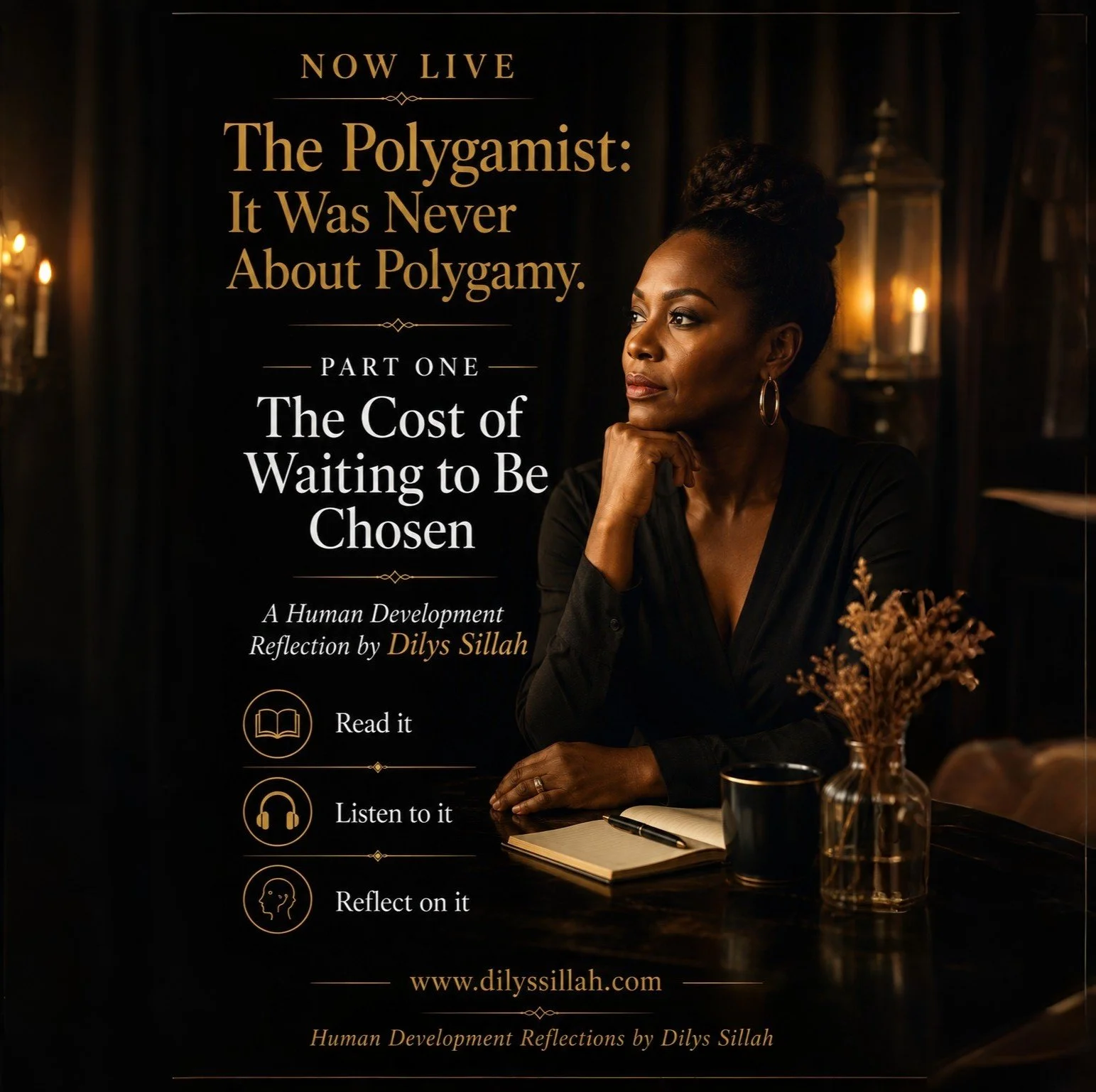
Listen to the blog here :
There is something about Essie that has stayed with me long after watching The Polygamist. It wasn't simply that she loved Jonasi, nor was it that she remained in a relationship that demanded far more from her than it ever gave back. It was the quiet familiarity of her story. Judging by the reactions to the series, many women recognised something of themselves in Essie. Some have even said they found the series too triggering to watch because they already knew it would awaken emotions they had worked hard to bury.
That response tells me this is about far more than one fictional character. Essie's story has become a mirror, reflecting experiences that countless women have lived but rarely examine. If we dismiss her as weak, foolish or desperate, we miss the opportunity to ask the more important question: what beliefs made her choices feel reasonable to her?
Human behaviour never exists in isolation. We do not wake up one morning and decide to spend years waiting for someone to love us properly. Our behaviour grows out of beliefs, experiences and messages that have been repeated so often they begin to feel like truth. Essie's decisions make far more sense when viewed through that lens.
One of the most significant things Essie did was remove accountability from Jonasi's life. That is not to excuse his behaviour. His lies, his manipulation, his neglect of his responsibilities as a partner and father all belong to him. He is responsible for every one of those choices. Yet relationships are systems, and systems develop patterns. Over time, Essie absorbed the consequences of his behaviour instead of requiring him to face them himself. Every time she accepted less than she deserved, the standard shifted a little further. Every compromise made the next compromise easier.
What fascinated me was not simply that she stayed. It was why staying made sense to her.
For many Black women, particularly within African communities, love has often been presented as something that is proved through sacrifice. We are praised for our endurance, admired for our patience and celebrated for standing by our men regardless of the personal cost. Choosing ourselves, on the other hand, is too often mistaken for selfishness. We are taught that a good woman carries the weight of the relationship without complaint, believing that if she loves deeply enough, gives generously enough and waits patiently enough, she will eventually be chosen.
Essie embodied that belief.
She invested years of her life into Jonasi. She gave him loyalty, emotional commitment and a daughter. Like many women, she invested not only in the man but in the future she imagined they would one day share. That is why leaving becomes so difficult. Walking away is not simply leaving a relationship. It is grieving a future that may never exist.
Grief is an uncomfortable emotion. It forces us to acknowledge that something we hoped for has died. Many women are not avoiding the man as much as they are avoiding the grief. It can feel easier to remain in denial than to confront the loss of the life we imagined we would have.
That is why I often think of Essie as someone sitting at a table convincing herself she is enjoying a three course meal while surviving on crumbs. It is not because she cannot see the crumbs. It is because accepting they are crumbs would require her to mourn the feast she believed was coming.
The tragedy is that many women have been taught to mistake waiting for faithfulness and endurance for love. We postpone our own dreams, our education, our businesses, our ambitions and sometimes even our identity because we believe we are investing in a shared future. We reassure ourselves that our sacrifice will one day be recognised. Sometimes it is. Sometimes the man succeeds and builds the life the woman always believed was possible.
The difficulty is that he does not always build it with her.
Essie's story exposes another uncomfortable truth. Women often speak about the years they have invested in a relationship. “I've been with him for ten years.” “We've built a life together.” “I can't start again.” Those words are deeply familiar because they are rooted in the fear that leaving would mean those years were wasted. It is the central wound I explore in When Love Feels One-Sided — the particular cost of pouring yourself into a relationship that was never equally shared, and why that imbalance is so much harder to leave than it looks from the outside.
Yet I rarely hear men frame relationships in quite the same way. Rarely do we hear, “I've already spent twenty years here, so I can't possibly begin again.” Women, however, frequently remain because they cannot bear the thought that everything they sacrificed might have been for nothing.
The irony is that remaining often requires sacrificing even more. That is the hidden cost of waiting to be chosen.
The longer I reflected on Essie, the more I realised that she wasn't simply waiting for Jonasi. She was waiting to be chosen. There is a profound difference between the two.
Women who have always known they are worthy of love tend to approach relationships very differently from women who have spent their lives trying to earn it. That difference often has very little to do with confidence and everything to do with where the story began.
One of the ideas I explore in my book Predator or Prince is that there is no such thing as an absent father. That may sound like a contradiction, but what I mean is this: a father may be physically absent, yet he remains psychologically present in the mind of his daughter. I call him the present absent father because, in his absence, she still has to make sense of who he is and what his absence says about her.
In doing so, many daughters create one of two versions of him. The first is the Hero Father. This is the father who would have been there if he could. His absence is explained away. There is always a reason, always a justification, always an excuse. None of them require him to carry responsibility because, in her mind, he remains a good father prevented by circumstances from showing up.
The second is the Villain Father. Here, his absence becomes rejection. She concludes that she was not worth staying for, not worth loving, not worth choosing. Those beliefs often manifest very differently in adulthood. Some women become emotionally unavailable. Others become fiercely independent. Some struggle to trust. Others refuse to be vulnerable again. The behaviours differ, but both women are responding to the same wound.
What struck me about The Polygamist was that we see this pattern emerging in the next generation. Essie's daughter spends much of the series protecting Jonasi's image. She explains his absence. She finds reasons for his failures. She clings to the belief that, underneath everything, he is still a good father. Watching her, I couldn't help but think of the Hero Father. She is already beginning to build the same internal narrative that so many daughters construct when the reality of a father's behaviour is too painful to accept.
Children do not simply inherit our genetics. They inherit our stories and the explanations we create to survive. That is why behaviour echoes across generations unless someone has the courage to stop and ask different questions.
Another moment in the series stayed with me because I suspect many women will recognise it immediately. Before Jonasi became the man we eventually came to know, he risked his own life to protect Essie from her violent boyfriend. He stood between her and a man everyone feared. It was an extraordinary act of courage.
For many women, moments like these become what I can only describe as the emotional golden ticket. One defining act becomes the benchmark against which every future disappointment is measured. “Yes, but he once…” “Yes, but he saved me…” “Yes, but he wasn't always like this…” We return to that single moment again and again, allowing it to outweigh years of behaviour that tell a very different story.
I have heard women defend men by saying, “He's a good provider.” Others will say, “He's a wonderful father,” or, “Deep down, he's a good man.”
Maybe.
There is another question that is often left unasked. Is he a good man to you? That question changes everything. A person can possess admirable qualities and still fail to create emotional safety within an intimate relationship. We sometimes confuse isolated demonstrations of love with a consistent pattern of loving behaviour. They are not the same thing.
This brings me back to a phrase that has become almost impossible to escape in conversations about relationships. “A man will go where he finds peace.” At first glance, it sounds wise. Yet the more I hear it, the more concerned I become about how it is being used.
Too often, it becomes a demand placed upon women rather than a standard expected of men. Women are told to remain calm, supportive, accommodating and emotionally available regardless of what is happening within the relationship. They are expected to create peace even when they are living with dishonesty, emotional neglect, betrayal or manipulation. The phrase rarely asks a different question: what if the man is the one creating the chaos?
If a woman is repeatedly lied to, emotionally destabilised or made to feel unsafe, her reactions are frequently judged while his behaviour escapes scrutiny. We call her emotional. We tell her she is difficult. We tell her she is no longer peaceful.
Peace is not the absence of emotion. It is the presence of emotional safety. You cannot continually sow chaos and expect to harvest tranquillity. You cannot repeatedly undermine someone's sense of security and then criticise the way they respond to feeling unsafe. Every action has consequences, and when those consequences appear in a woman's behaviour, they are too often mistaken for her personality rather than recognised as her response to the environment she has been living in.
Essie reminds us that human behaviour rarely begins where we think it does. It begins much earlier, and unless we understand where it began, we risk repeating it.
Healing Begins with Choosing Yourself
Maybe the greatest tragedy in Essie's story is not that Jonasi failed to choose her. It is that somewhere along the way, she stopped choosing herself. That is not a criticism; it is an observation.When we spend years seeking validation from another person, our own voice gradually becomes quieter. We begin measuring our worth by someone else's willingness to love us, commit to us or remain with us. Without realising it, we hand over responsibility for our sense of value to another human being. That is a heavy burden for anyone to carry, because no one else can give us what we have not first recognised within ourselves.
Healing begins with a different decision, one that starts with a question many women have never been encouraged to ask: what would choosing myself look like? It is the question at the heart of When Letting Go Means Choosing You, which explores what it actually looks like to prioritise yourself after years of placing someone else at the centre of your world.
For some, choosing yourself means developing self-respect where there has only been self-sacrifice. For others, it means recognising that emotional abuse, manipulation, dishonesty and fear should never be accepted as the price of love. For many, it means confronting the fear of being alone, the fear of starting again, the fear of judgement or the fear that life has somehow passed them by.
Those fears are real and they cannot be dismissed with positive affirmations or slogans. They have often been shaped over decades through childhood experiences, family relationships, cultural expectations, religious teachings and painful disappointments. That is why healing takes courage. It asks us to grieve not only the relationship we lost, but sometimes the childhood we never had, the father who never came, the future we imagined and the version of ourselves that kept believing that one more sacrifice would finally make us enough.
The grieving and the healing often happen together; one does not wait for the other to finish. As we release what never was, we slowly begin reclaiming what has always been ours.
This is where my Glass Framework™ becomes so important. I do not believe that human beings begin life broken. I believe we begin life whole. The experiences we encounter, particularly in childhood and in our closest relationships, do not remove our worth. They affect our capacity to experience and express it. They cloud it. They distort it. They sometimes convince us that we are less than we truly are. They do not change our inherent value. That distinction matters.
If I believe I am broken, my life's work becomes trying to become someone new. If I understand that I was born whole, my life's work becomes returning to the person I have always been beneath the hurt, the fear and the beliefs I inherited. That is a very different journey.
Maybe that is why so many women found Essie's story so painful to watch. They were not simply watching her, they were remembering themselves. They recognised the years spent hoping. They recognised the compromises. They recognised the justifications. They recognised the moments they accepted crumbs because they could not bear to admit the feast they had been promised was never coming. In recognising all of that, something else becomes possible; not immediately, and not without grief, but possible.
If that was your experience, I hope this reflection has offered something more than analysis. I hope it has offered understanding, because understanding changes the question. The question is no longer, “Why didn’t he choose me?” The question becomes, “What has stopped me from choosing myself?” That is not the end of the journey…it is the beginning.
Healing doesn’t begin when someone finally chooses you, it begins the moment you remember your worth was never dependent on being chosen in the first place.
If this reflection has raised questions about your own relationships or the beliefs that have shaped them, you may wish to explore my books, the Glass Framework™, or the other reflections available on my website. For those who would prefer to explore these themes more personally, I also work with individuals through private consultations.
Dilys Sillah
Human Development Practitioner
Creator of The Glass Framework™
CONTINUE READING
If this reflection resonated with you, you may also wish to explore these ideas further.
Predator or Prince — How to find the man of your dreams, not your nightmares
When Love Feels One-Sided— Understanding one-sided love and finding your way back to yourself
When Letting Go Means Choosing You — The emotional reality of choosing yourself after loss
The Glass Framework™— An original human development methodology